Chapter 11 Bankruptcy Costs: Legal Fees, DIP Financing, and Reorganization Requirements
A detailed breakdown of Chapter 11 corporate restructuring costs, including statutory court fees, legal retainers, Subchapter V small business rules, DIP financing terms, and reorganization timelines.
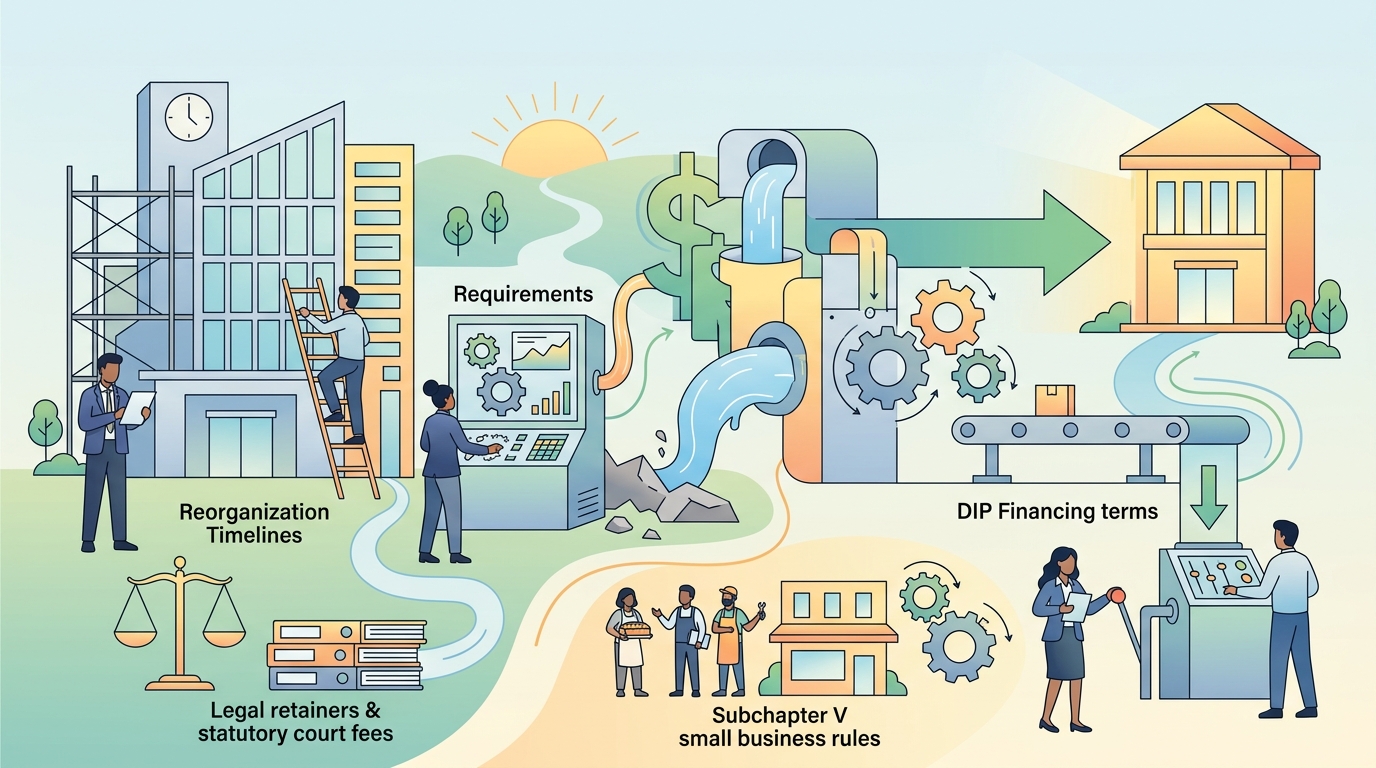
Overview of Chapter 11 Corporate Restructuring Costs
Chapter 11 bankruptcy is a legal process established under federal law designed to help distressed organizations restructure their financial obligations, reorganize business operations, and emerge as viable going concerns under court protection (Source 1). While restructuring provides relief from immediate collection actions, evaluating the total chapter 11 bankruptcy cost requires a complete analysis of mandatory administrative fees, professional advisory retainers, operational oversight, and specialized credit facilities.
For corporate debtors, restructuring costs fall into two distinct categories: direct administrative fees paid to federal courts and financial advisors, and indirect operational expenses incurred during the proceeding. The final expense varies dramatically depending on whether a company files under traditional Chapter 11 or under Subchapter V, a streamlined framework designed specifically for eligible small business debtors.
Initial Court Filing Fees and U.S. Trustee Quarterly Expenses
Entering federal bankruptcy protection requires initial statutory filing payments established by federal court fee schedules. As established in the official fee schedules of the United States Courts, filing a Chapter 11 petition requires an initial filing fee of $1,167 plus a $571 administrative fee, bringing the baseline initial court cost to $1,738.
Beyond entry fees, reorganizing corporations must pay ongoing quarterly oversight fees to the Office of the United States Trustee, a division of the U.S. Department of Justice. According to statutory fee schedules published by the U.S. Trustee Program, these fees are calculated as a percentage of total quarterly cash disbursements made by the debtor-in-possession. For small enterprises disbursing less than $150,000 per quarter, statutory fees remain at fixed lower baseline amounts. However, for large corporations disbursing tens of millions of dollars quarterly, U.S. Trustee fees scale incrementally up to statutory caps per quarter until the court confirms a Plan of Reorganization or closes the case.
Corporate Restructuring Legal Fees: Traditional vs. Subchapter V
Legal representation constitutes the largest single component of corporate restructuring legal fees. In traditional Chapter 11 cases, corporate debtors must retain primary bankruptcy counsel, specialized conflicts counsel, and financial restructuring advisors. Official bankruptcy court fee dockets show that senior bankruptcy partners at major national law firms bill hourly rates ranging between $1,000 and $2,200, while associate rates typically span $600 to $1,200 per hour.
Before filing a petition, restructuring law firms routinely require upfront cash retainers. Fee application records indicate initial retainer expectations based on corporate size:
- Small to Middle-Market Companies ($10M–$50M liabilities): Retainers typically range from $150,000 to $500,000.
- Mid-Sized Enterprises ($50M–$250M liabilities): Retainers range from $500,000 to $1,500,000.
- Large Corporate Cases ($250M+ liabilities): Upfront legal retainers often exceed $2,000,000 to $5,000,000.
To address these high barriers, Congress enacted the Small Business Reorganization Act, establishing Subchapter V within Chapter 11. The subchapter 5 small business bankruptcy cost profile is substantially lower due to procedural efficiencies. Subchapter V eliminates official committees of unsecured creditors, dispenses with separate disclosure statements, and removes quarterly U.S. Trustee fee obligations, substituting a standing trustee who facilitates plan consensual approval.
| Cost Category | Traditional Chapter 11 | Subchapter V Small Business |
|---|---|---|
| Statutory Filing Fee | $1,738 baseline fee | $1,738 baseline fee |
| Typical Legal Retainer | $150,000 – $2,000,000+ | $25,000 – $75,000 |
| Average Total Professional Fees | $500,000 to tens of millions | $50,000 – $150,000 typical range |
| U.S. Trustee Quarterly Fees | Required (based on disbursements) | Exempt from statutory fees |
| Creditors' Committee Costs | Debtor pays committee professionals | No unsecured committee appointed |
Debtor-in-Possession (DIP) Financing: Structures and Rates
Companies entering reorganization frequently require specialized liquidity known as Debtor-in-Possession (DIP) financing. DIP loans provide cash to sustain operations, meet payroll, and pay court-approved professional fees while the company restructures its balance sheet.
Because financing a bankrupt entity carries operational risks, lenders receive primary statutory protection under Section 364 of the Bankruptcy Code. Courts can grant DIP lenders 'super-priority' administrative claim status, placing their repayment obligation ahead of all pre-petition unsecured debts and standard administrative claims.
According to debt capital market pricing reports and bankruptcy court filings, debtor in possession financing rates carry a premium above standard corporate credit facilities. Typical DIP financing cost parameters include:
- Base Interest Rates: Floating benchmark rates (such as SOFR) plus a margin spread ranging from 5.00% to 10.00% per annum.
- Commitment & Upfront Fees: Lenders charge initial arrangement or commitment fees ranging from 1.5% to 3.5% of the total loan facility.
- Exit Fees: Structured fees paid upon plan confirmation, often between 1.0% and 2.0% of the committed capital.
- Roll-Up Provisions: Existing secured lenders may offer DIP loans contingent on 'rolling up' pre-petition debt into senior DIP status, effectively increasing the guaranteed coverage for prior obligations.
Timeline and Financial Milestones in a Reorganization Plan
Developing, negotiating, and confirming a Plan of Reorganization follows strict federal procedural steps under court supervision (Source 1). The total duration of the bankruptcy case directly impacts legal fee accumulation and overall administrative cost.
Key financial and legal milestones along the reorganization timeline include:
- Day 1 to 30 (First Day Relief): Filings for emergency orders allowing the debtor to pay prepetition payroll, maintain banking relationships, and access interim DIP funding.
- Day 1 to 120 (Exclusivity Period): Under traditional Chapter 11, the debtor holds the exclusive right to propose a reorganization plan for 120 days, expandable up to 18 months upon showing good cause.
- Month 3 to 6 (Subchapter V Deadline): Subchapter V mandates that the debtor submit a reorganization plan within 90 days of filing, significantly accelerating case resolution.
- Disclosure Statement Approval: In traditional cases, the court must approve a disclosure statement providing adequate financial information before creditors can vote on the plan.
- Plan Voting & Confirmation Hearing: Creditors vote by class. If at least one impaired class accepts the plan, the debtor may seek 'cramdown' confirmation under Section 1129(b) to bind dissenting creditor classes.
Impact on Vendor Contracts, Commercial Leases, and Secured Creditors
The initiation of a Chapter 11 proceeding triggers the automatic stay under federal law, instantly halting judicial collection actions, foreclosures, and asset seizures (Source 1). This statutory hold gives management room to restructure operational liabilities.
Section 365 of the Bankruptcy Code grants debtors broad powers to evaluate executory contracts and unexpired commercial leases. The company can select one of three statutory pathways:
- Assumption: The debtor retains the contract or lease, agreeing to cure all pre-petition monetary defaults ('cure costs') and provide adequate assurance of future performance.
- Rejection: The debtor cancels unprofitable contracts or leases. Rejection constitutes a pre-petition breach, converting lease termination damages into general unsecured claims paid at pennies on the dollar.
- Assumption and Assignment: The debtor assumes valuable contracts or leases at market or below-market rates and sells them to third parties, generating cash assets for the bankruptcy estate.
Secured creditors retain protection to the value of their collateralized assets. Debtors must provide 'adequate protection' payments to offset any depreciation in collateral value during the case. If the collateral value exceeds the debt owed, the secured creditor may claim post-petition interest and reasonable legal fees under Section 506(b).
Financial Summary: Cost Elements of Corporate Reorganization
Below is an overview of standard cost line items encountered during a corporate Chapter 11 reorganization, compiled from bankruptcy clerk schedules and restructuring industry benchmarks.
| Expense Category | Source / Authority | Typical Fee / Rate Range |
|---|---|---|
| Court Filing Fee | U.S. Bankruptcy Court Fee Schedule | $1,738 fixed statutory fee |
| U.S. Trustee Quarterly Fees | 28 U.S.C. § 1930(a)(6) | Tiered percentages based on disbursements (Exempt in Subchapter V) |
| Lead Restructuring Counsel | Law firm billing dockets | $600 – $2,200 per hour depending on attorney seniority |
| Financial Advisory / Restructuring | Investment banking dockets | $25,000 – $150,000 monthly retainer + success completion fee |
| DIP Financing Interest Rates | Commercial lending benchmarks | SOFR + 5.00% to 10.00% spread (+ 1.5% - 3.5% upfront fee) |
| Subchapter V Trustee Compensation | 11 U.S.C. § 330 | Hourly billing paid by debtor (typically $300 – $600/hr) |
What is the primary cost advantage of Subchapter V for small businesses?
Subchapter V significantly lowers legal and administrative costs by eliminating official creditors' committees, waiving U.S. Trustee quarterly fees, omitting separate disclosure statements, and accelerating the reorganization plan filing deadline to 90 days.
How do U.S. Trustee quarterly fees impact a reorganizing corporate debtor?
In traditional Chapter 11 cases, U.S. Trustee fees are assessed quarterly based on total monetary disbursements made by the company. Large companies disbursing high operational volumes pay quarterly fees based on statutory rate tiers until the bankruptcy case closes or confirms a plan.
What happens to unexpired commercial leases during a Chapter 11 proceeding?
Under Section 365 of the Bankruptcy Code, the debtor can assume valid leases by curing past financial defaults, reject burdensome leases to limit future damages to general unsecured claims, or assign favorable leases to third-party buyers to raise capital.
Sources
- Understanding Bankruptcy Basics — Consumer Financial Protection Bureau
This article is for general information only and is not professional advice. Figures come from public sources and change over time; check the official source before you act.
More from Daily Facts Wire
- 5 Lifeline Phone Application Mistakes That Stop Your Monthly Benefits
- 7 Income Rules That Qualify You for a Free Smartphone Today
- The 4.5GB Smartphone Data Secret Millions Miss Each Month
- Get Your Free Smartphone Through Federal Lifeline and Meta Promo Rules
- 4 Costly Mistakes People Make Claiming Free Phones On Facebook
- The $35 Hidden Activation Fee Inside Free Meta Phone Offers